


【Children in Rural Areas Services】The Boy Who Rides a Unicycle in Confidence
Hao the Unicyclist: What Long School Breaks Look Like for Children in Rural Taiwan?
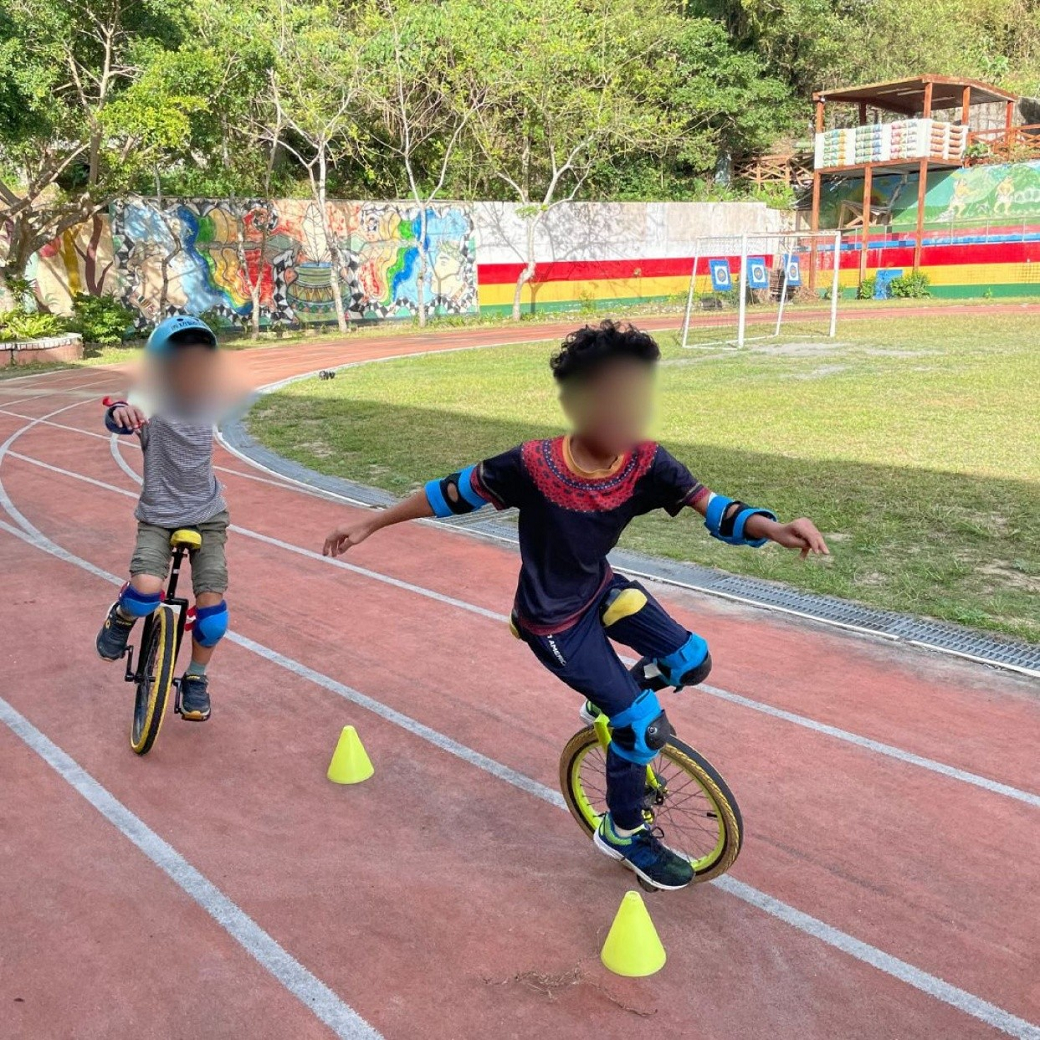
"Keep your balance. Take a smaller turn..." In the bright afternoon sun, the coach's crisp instructions echo across a hillside school field. One by one, the children shift back and forth on their unicycles like living scales, eyes fixed and bodies steady as they search for that perfect center point. Among them is Hao, a third-grader who has already placed in the top three in unicycle racing. To his family, teachers, and classmates, he's quick-witted, imaginative, and always ready with a perfectly timed joke. But the moment he gets on a unicycle, a different side of him shows up: focused, quiet, and fully present as he works for balance.
In past winter and summer breaks, Hao's days were mostly spent sleeping, drifting around, watching TV, or scrolling on a phone. After his parents divorced, Hao was raised by his father alongside cousins who had lost parental care. The family all lived together with their grandparents. With the family's finances resting heavily on his father and grandfather, the adults were busy trying to make ends meet. For Hao, that often meant having to fill the long school break on his own.
Through Hao’s story, we’re reminded of several realities that shape life for children in rural Taiwan:
According to a CWLF survey:
- 67% of children in rural communities say they spend school breaks at home, mostly watching TV or scrolling on their phones.
- 9% pass the time by visiting shopping streets, malls, or night markets.
- 3% choose ball sports or other active play.
2. Why Are Children in Rural Taiwan More Vulnerable to "Summer Slide"?
- Geographic barriers: Many rural schools are located far from population centers, making it difficult to recruit and retain qualified teachers.
- Caregiver constraints: Beyond the overall lack of recreation and enrichment options in rural areas, many caregivers—especially in families under financial strain—work long hours or take jobs away from home. That leaves limited time to supervise, plan, or support after-school and break-time activities.
- Limited financial resources: Some rural families are unable to afford the high costs associated with camps or after-school programs.
3. What Else Contributes to "Summer Slide" for Children in Rural Taiwan?CWLF survey also found that many children carry significant family responsibilities during school breaks:
- 58% help with household chores such as laundry and cleaning.
- 2% support the family by helping with a family business or taking paid work.
- 5% provide day-to-day assistance to family members.
How CWLF Helps Children in Rural Taiwan Prevent
- CWLF partnering with caring companies and the public to fund school-based break camps. For the past 14 years, CWLF has worked with corporate partners and supporters to help schools run holiday enrichment camps. To date, we have supported 1,889 schools in delivering 2,687 camp sessions, reaching more than 64,146 children.
- CWLF’s Nutrition Subsidy and Long Vacation Camp Program
CWLF has provided nearly 54,070 nutrition packages to help children stay nourished during long school breaks and reduce the "nutrition gap" that many children in families experiencing adversity.
How Does CWLF’s Children in Rural Areas Services Help Prevent Summer Slide?
CWLF’s approach to supporting children during long school breaks is built on an inter-school collaboration model.
- What is the inter-school collaboration model?
Rural teachers often share a common concern: “After six months of hard work, one long break can reset everything.” This sentiment highlights a significant challenge many rural children encounter when school is not in session. CWLF also recognizes that many educators want to minimize the risks associated with children being unsupervised or spending too much time on screens during breaks. Additionally, there is a desire to help broaden their horizons. To address these concerns, CWLF has developed an inter-school collaboration model as part of our Children in Rural Areas Services.
Through this model, rural teachers can apply to CWLF for camp funding and are encouraged to offer more break-time camps and club activities, allowing children to have a safer, more structured, and more engaging school break. With these camps in place, children have space to play and learn in a supportive environment, rather than spending whole days alone with phones or TV.
At Hao’s school, for example, the unicycle training camp helps students build on what they practice during the school-year club. It keeps students’ skills from fading during the break. Hao is now confidently coaching younger students. He tells them, "At first you’re scared of falling. Once you can ride, you’re not. If you’re not willing to fall, you won’t improve!"
Many children like Hao can join school-run camps for free with our support. Hao shared happily, "this break, I learned leathercraft, soccer, and songs. I also had more time to practice unicycling, so my skills got stronger. I hope there’s an inline skating class next time. I didn’t know school breaks could be as fun as school!"
CWLF aims to expand learning and recreation opportunities for children in families facing hardship during school breaks, helping to narrow the learning gap between rural and urban communities.
◼︎ More information for Children in Rural Areas Service:
Children in Rural Areas Services
◼︎ More CWLF stories:
2025 World Children's Day: What CWLF Child Wellbeing Survey Reveals about Children's Lives in Taiwan
【Children in Rural Areas Services】Quan: The Boy Who Builds a Wall Around His Heart
【Family in Adversity Services】From Storm to Strength: How Fang-Fang's Family Found Hope Again